 English
 Español
In the Digital Air Oven industry, the Heating Element performance directly determines the preheating speed, temperature control precision, and final food texture. Currently, the two mainstream technical solutions in the market are Quartz Tube and Stainless Steel Heating Tube. This article provides a professional comparison from the perspectives of physical properties, thermal efficiency, safety, and lifespan.
Technical Characteristics of Quartz Tube
A Quartz Tube consists of a quartz glass tube and a built-in resistance wire (usually nickel-chromium alloy). It operates by converting electrical energy into heat, which is emitted as Far Infrared radiation.
Extreme Thermal Efficiency
The biggest advantage of the Quartz Tube is its extremely fast thermal response. Quartz glass has excellent permeability, allowing the heat generated by the resistance wire to be released instantly as infrared radiation without a long preheating process. In a Digital Air Oven, this means users can achieve "instant-on" cooking, significantly shortening the total cooking time.
Penetration and Food Texture
Far Infrared rays have strong penetration power, acting directly on the internal molecules of the food. For meat, Quartz Tube technology can quickly lock in juices to achieve a Crisp exterior and tender interior. When executing the Air Fry function, its radiant heat efficiency is generally superior to thermal convection efficiency.
Fragility and Limitations
Despite its superior performance, the physical nature of Quartz Tube is fragile. It cannot withstand severe mechanical impact and is prone to embrittlement after long-term high-temperature operation. Furthermore, because the surface heats up extremely fast, grease splashes can cause localized uneven heating or even tube rupture, as they are harder to clean compared to metal tubes.
Technical Characteristics of Stainless Steel Heating Tube
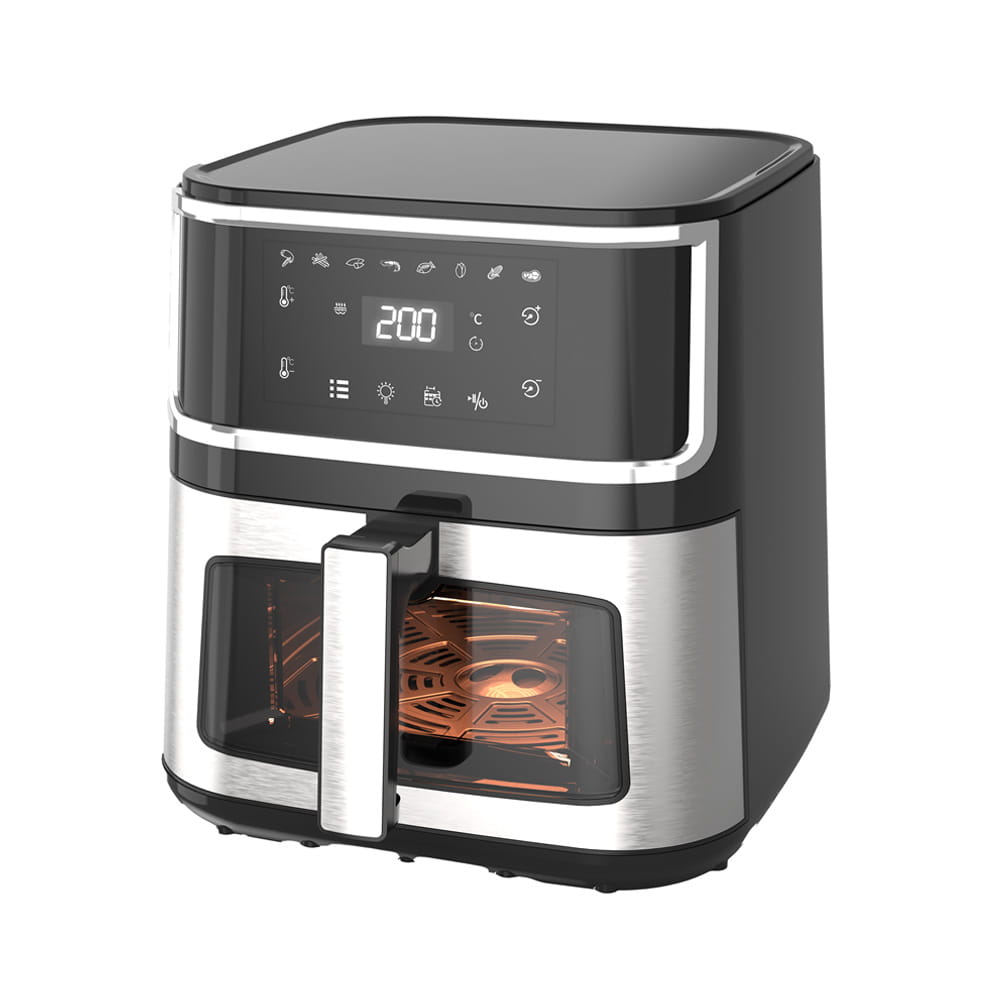
The Stainless Steel Heating Tube (often referring to M-Type or straight metal heaters) consists of a metal shell, resistance wire, and insulating filler like magnesium oxide powder. it is the most mature and widely used solution in the Digital Air Oven field.
Superior Durability
Compared to quartz, Stainless Steel Heating Tube offers high resistance to impact and corrosion. Even under high temperatures, it will not be damaged by minor collisions or grease splashes. For Commercial or heavy-duty household scenarios, it provides much higher reliability.
Uniform Heat Distribution
Heat transfer in stainless steel tubes relies mainly on Convection and conduction. By optimizing the tube path (such as an M-shaped design), the heating surface area is expanded. When combined with the high-speed fan of a Digital Air Oven, it creates a very uniform Convection environment. This is crucial for Baking items like Bread or Cake that require a highly stable temperature field.
Thermal Inertia
The disadvantage of stainless steel tubes is the slower preheating speed, resulting in Thermal Inertia. When a PID control algorithm is involved, the slow cooling rate can lead to temperature Overshoot. However, once stabilized, this inertia provides a more consistent temperature field with fewer fluctuations during the cooking cycle.
Quartz Tube vs Stainless Steel Heating Tube: Professional Comparison
To assist industry clients in decision-making, the core differences are summarized below:
| Metric | Quartz Tube | Stainless Steel Tube |
| Preheating Speed | Extremely Fast (< 30s) | Slower (3-5 min) |
| Heat Transfer | Far Infrared Radiation | Convection & Conduction |
| Durability | Fragile, sensitive to oil | Robust, corrosion-resistant |
| Control Precision | Fast response for instant adjustment | Slower response, stable thermal mass |
| Common Applications | Compact Air Fryers | Large Digital Air Ovens |
Industry Trend: Hybrid Heating Systems
As Digital Air Oven technology evolves, more High-end products are adopting Hybrid Heating solutions. For example, placing two Quartz Tubes at the top for instant Crisp results, while using Stainless Steel Heating Tubes at the bottom to ensure long-term thermal support and even browning.
This combined approach, integrated with PID algorithms, allows the machine to dynamically adjust power distribution across different heating elements based on modes like Bake, Broil, or Air Fry. For users seeking the ultimate cooking experience, this multi-source coupling technology represents the current peak of the market.